
Why Voice Reminders Work Better for Aging Parents
We live in an era of constant notifications — buzzes, banners, and badge counts that pile up unread. For most adults, these signals are easy to process and dismiss. But for aging parents, particularly those managing chronic conditions, cognitive changes, or hearing difficulties, a generic phone buzz means very little.
What does cut through? A familiar voice. Specifically, your voice — the person they trust most. Research in gerontology consistently shows that older adults respond more reliably to spoken, personalized cues than to text-based or visual alerts. The emotional resonance of a known voice activates memory pathways that a screen notification simply cannot.
The Science Behind It
Auditory memory is deeply tied to emotional processing. When your mother hears your voice saying "Mum, time to take your blood pressure pill" — even as a recording — her brain doesn't process it as an automated reminder. It processes it as you reaching out. That emotional activation makes the action far more likely to happen.
For seniors experiencing early cognitive decline, familiar voices are also orientation anchors. They reduce confusion and provide reassurance. A text message from an app might be disregarded or misunderstood; a voice from a loved one carries meaning that transcends the content.
What Makes Pavili Different
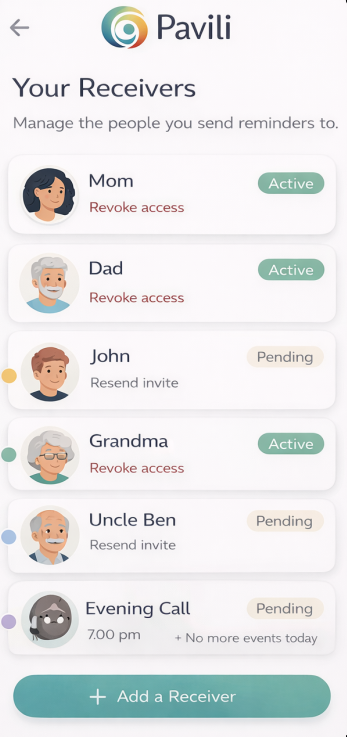
Pavili lets you record reminders in your own voice and schedule them to play at specific times — not "around noon," but 12:07pm exactly. Your parent receives the reminder as you recorded it, playing automatically. They can acknowledge it with a single tap, snooze it, or request a call-back — all without needing to navigate menus or type anything.
You, as the sender, see when they acknowledged it. If they don't respond, Pavili's follow-up logic sends a second gentle reminder. You stay informed without needing to make a call every morning.
Practical Setup Tips
- Keep messages short and warm. "Good morning Dad, time for your walk. I love you." works better than a list of instructions.
- Schedule at habitual times. Attach reminders to existing routines — after breakfast, before bed — to leverage existing behavioral anchors.
- Use a quiet, clear recording environment. Background noise reduces comprehension, especially for those with hearing aids.
- Enable follow-ups. If they don't acknowledge within 15 minutes, a second reminder plays automatically.
Long-distance care is never easy. But voice reminders let you be present — in the most meaningful sense — even when you're thousands of miles away.
Start caring with your voice
Set up your first voice reminder for a loved one in under 2 minutes.
Get Started Free